
Washerwoman, Shannon Alonzo, 2018
1. Introduction
In October 2024, a group of UCL academics and students visited an exhibition at the Wellcome Trust entitled ‘Hard Graft: Work, Health and Rights’. I had been asked by my colleague, Humera Iqbal, to lead a discussion after the exhibition. The invitation to lead a discussion on an exhibition is surprising for a labour lawyer: it is not often that we are asked to comment on visual arts.
The exhibition explores the impact of precarious work on health, and is powerful, thought-provoking and upsetting. Its choice of themes is no coincidence. It is divided into three main sections: ‘The Plantation’, ‘The Street’ and ‘The Home’. Each of these sections contains exhibits, including photos, videos, installations and other objects that demonstrate the effects of precarious work on people’s health, and ways in which workers, individually and collectively, attempt to counteract exploitation and its effects on their bodies.
In all three locations – the plantation, the street and the home – legal rules that regulate labour exclude precarious workers from labour rights that other people have and increase their vulnerability to exploitation. In my book Structural Injustice and Workers’ Rights, I discussed the legal regulation of migrant labour, including domestic and agricultural work, work in prison and immigration detention, zero-hour contracts, agency work and other precarious work. I explained how the state may be held responsible for the exploitation of precarious workers, because through legal rules with an appearance of legitimacy, it creates what I described as ‘state-mediated structures of exploitation’. These legal rules may violate workers’ rights under human rights law.
Even though labour law scholars know all too well that weak legal regulation of precarious work can lead to exploitation, we do not often consider the effects of precarious work and its regulation on workers’ health. The Wellcome Trust exhibition invites us to do just that. The implication is that better regulation of precarious work and stronger enforcement of the labour rights of precarious workers will not only protect them from exploitation but will also improve their physical and mental health.
2. The Plantation – The Prison
The Plantation section of the exhibition presents images of hard, and often monotonous work in plantations across the world, including images of workers under colonial rule and during slavery. It explains that work in plantations happens nowadays too in working conditions that are severely exploitative, and highlights the effects of this work on the environment and its impact on racialised groups.
There are clear connections between taxing work in plantations and contemporary working conditions in agricultural work across the globe. Agricultural work is a low paid sector, with a high concentration of workers under temporary visas in many countries, which compound their vulnerability. These visas contain restrictive conditions, making workers dependent on intermediaries, having a temporary, seasonal status and other such factors. The exhibition’s Guide explains that work in plantations has severe effects on the bodies of workers, including malnutrition, injury and premature death. According to estimates of the International Labour Organisation, over 170,000 agricultural workers are killed each year at work around the world. In the UK, since 2019, following the decision to leave the EU, the Government introduced a Seasonal Worker Visa. The aim of this scheme was to cover post-Brexit labour shortages but it has been severely criticised for its effects on workers’ rights. Emiliano Mellino and Matthew Chapman investigated the treatment of seasonal workers in agriculture under the Seasonal Worker Visa scheme, and found exploitation and appalling working conditions: one worker said that ‘all that is missing is a whip’.

Daybreak – A Time to Rest, Jacob Lawrence, 1967
This section of the exhibition also refers to prison labour, drawing connections between slavery and work in prison. These connections are obvious when thinking about the US, where there is racialised mass incarceration. A piece in The Atlantic that I read in the past entitled ‘American Slavery, Reinvented’, accompanying a short documentary called ‘Angola for Life’, emphasises these connections and contains haunting images of slavery and racial oppression in a maximum security prison in the US South. The exhibition shows that the British prison system was inspired by the American one, and includes photos of prisoners on a treadwheel at Pentonville Prison, London, in 1895 and a lithograph poster with the slogan ‘Jail is just a kind of warehouse for poor people’.

Prisoners on a treadwheel at Pentonville Prison, Unknown author, 1895/2024
Prisoners are often required by the prison authorities to work while in prison, both for the prison and for private employers, while being excluded from labour rights. For instance they do not have a right to a minimum wage, as I explained in a piece published in this blog. Instead, the minimum weekly rate is just £4. The prison system and the regulation of prison work creates the conditions for them to fail at rehabilitation, and the exhibition highlights that.

Jail is just a kind of warehouse for poor people, Peg Averill, 1976
3. The Street
In The Street, we see powerful photos and videos of sanitation workers who clean streets in cities, in a sector where work can damage health because of pollution, while being undervalued and underappreciated, as well as images of their solidarity marches and strikes demanding better working conditions.
The Street also presents the risks on health faced by sex workers. Sex work is prohibited to varying extents in many countries. In much of the US, for instance, it is fully criminalised, which means that it is a criminal offence to sell or pay for sex. In the UK it is partially criminalised: it is not a criminal offence to exchange sex for money, but other related activities, such as advertising in certain areas and running a brothel, are a criminal offence. In New Zealand, where sex work has been decriminalised, some of the key stated purposes of the legislation were to protect the human rights of workers, to promote their welfare, and health and safety, and to promote also public health (Prostitution Reform Act, s 3). The exhibition here presents the value of collective organising for sex workers, who campaign for their rights and emphasise the importance of decriminalising sex work for reasons of health and safety, class and gender equality.
‘No one screws more prostitutes than the government’ is a slogan that appears in one of the exhibition’s posters by the English Collective of Prostitutes that promotes the message that sex work ought to be fully decriminalised. The role of the law and unionising for sex workers have also been covered in this blog in pieces by Danielle Worden and Katie Cruz. Vagrancy laws, which exist in the UK and other legal orders also criminalise aspects of street life and may lead to prosecutions of people working in the streets, including sex workers and street vendors (I discuss vagrancy laws and their effects in my paper in the book Structural Injustice and the Law).
The campaigns of street workers, protests and strikes that are especially emphasised in this section, make them visible and put pressure for the improvement of their working conditions and better regulation of their sector.

No one screws more prostitutes than the government. In 1990 prostitutes were fined £1/2 million, Bartle Bogle Hegarty (designer) for English Collective of Prostitutes
4. The Home
The final section of the exhibition turns to The Home. Home is our private space, where we rest and engage in personal and intimate relationships. For domestic workers, though, other people’s homes are their workplaces, as the exhibition highlights making visible a work sector that is normally invisible because of its location.
Domestic work, mostly performed by women, is an essential and undervalued sector. Many women in the UK and other countries can participate in the labour market outside home only because they can employ domestic workers to clean, cook or look after children or others in need of care. Work at home remains undervalued and gendered, and the feminist project remains unfinished, as Barbara Ehrenreich explained.
Domestic work can be challenging, hazardous and exhausting, and the exhibition presents images that emphasise that. The sculpture of a Washerwoman (by Shannon Alonzo), who is headless but whose body clearly reflects the marks of harsh work, is especially striking.

Washerwoman, Shannon Alonzo, 2018
The living space for domestic workers in luxurious homes, reflected in architectural designs presented in the exhibition (The Maids Rooms: La Encantada, Artadi Architects, by Daniela Ortiz), further emphasises the oppression and segregation experienced by these workers (on this, see further Matthew Reynolds, ‘Downstairs, upstairs: the division of domestic space between domestic workers and super-rich employers in London’, (2022) Architecture and Culture).

‘The maid’s room’, Johannesburg, Transvaal (Gauteng), 24 July 1969, David Goldblatt, 1969/2024
Domestic workers are excluded from several labour rights that other workers enjoy, particularly when they live in the employer’s home (live-in domestic workers). In the UK, for instance, they are excluded from Working Time Regulations, while only very recently has an exclusion from Minimum Wage Regulations been rectified following campaigns and litigation in Employment Tribunals (see this blog post by Natalie Sedacca).
Crucially, because domestic workers are employed in private homes, they are also excluded from the Health and Safety at Work Act 1974 through section 51, which explicitly excludes domestic work in order to protect the employers’ privacy.
The UK has not ratified the International Labour Organisation Convention on Domestic Workers (No 189), stating that ‘we do not consider it appropriate, or practical, to extend criminal health and safety legislation, including inspections, to cover private households employing domestic workers. It would be difficult, for instance, to hold elderly individuals, who employ carers, to the same standards as large companies’ (statement by Ms Warwick, International Labour Conference Record of Proceedings 15 June 2011, 25 (rev), 22). (see further this piece). The tension between privacy at home, on the one hand, and protection of domestic workers’ rights on the other, has been resolved in other countries that permit health and safety inspections under specific conditions.
One of the concluding exhibits is ‘Our Journey’, a digital video by Dr Joyce King, Tassia Kobylinska and The Voice of Domestic Workers. In this participatory film workers talk about the exploitation and ill-treatment that they experience while cleaning private homes. The UK Overseas Domestic Worker Visa is particularly highlighted. We have this visa scheme in the UK since 2012, which effectively ties migrant domestic workers to the employer with whom they arrived in the country. It makes it almost impossible for these workers to change employer, even if they have been seriously exploited and abused (on this visa, see further this blog post, co-authored with Natalie Sedacca).
Organisations on the rights of domestic workers, such as Kalayaan and the Voice of Domestic Workers, have been asking the Government to revert to the pre-2012 visa scheme for domestic workers, when workers had an unconditional right to change employer and a route to settlement. Very little has changed, despite these concerted efforts and the supposed commitment to tackle what is described as ‘modern slavery’. In interviews of domestic workers under the UK visa scheme that I conducted in 2015, some workers spoke to me about health issues and concerns, such as high blood pressure and arthritis, but explained that they were too fearful to go to the doctor because of their legal status: they were undocumented, having escaped exploitative employers, and preferred to live away from the public eye. Secure legal status for migrant domestic workers, who perform crucial care and other work in UK private households, will both protect them from exploitation and support their physical and mental health.
‘Domestic workers are the unsung heroines in this country and globally’, said the Constitutional Court of South Africa in Mahlangu, a judgment that examined the treatment of domestic workers in South Africa. Having been employed as a domestic worker for the same family for 22 years, on 31 March 2012 Ms Mahlangu drowned in her employer’s pool while carrying out her work. She reportedly could not swim and was partially blind. When her daughter attempted to claim compensation for her death at work, she found that legislation excluded domestic workers from a right to compensation for accidents at work. The Court found that the exclusion of domestic workers from social security legislation violated the right to social security, equality and dignity in the South African Constitution (see this blog post, co-authored with Natalie Sedacca).
5. Conclusion
Precarious work ‘reinforces health inequalities’, explains the description of the exhibition, with race, gender and poverty being key themes. What underlies and is sometimes made explicit in parts of this exhibition is the responsibility of state authorities for legal rules that reinforce precariousness, create and sustain structures of exploitation and have serious effects on workers’ health.
The Marmot Review analysed the social determinants of health that are associated with health inequality, including lower life expectancy, and discussed the role of precarious working arrangements and the importance of fair work in this context (see particularly the Marmot Review Ten Years On). This exhibition focuses on some of the most precarious work sectors and reminds us, in a most powerful way, that the state has the responsibility to protect precarious workers not only in order to address inequality and exploitation, but also in order to tackle the harsh effects of precarious work on people’s health.
This exhibition is challenging, at times emotional, thought-provoking and even disturbing. It is strongly recommended to anyone who is interested in precarious work and workers’ rights.
The exhibition ‘Hard Graft: Work, Health and Rights’ is free and on until the 27th of April 2025 at the Wellcome Trust, 183 Euston Road, London NW1 BE.
About the author
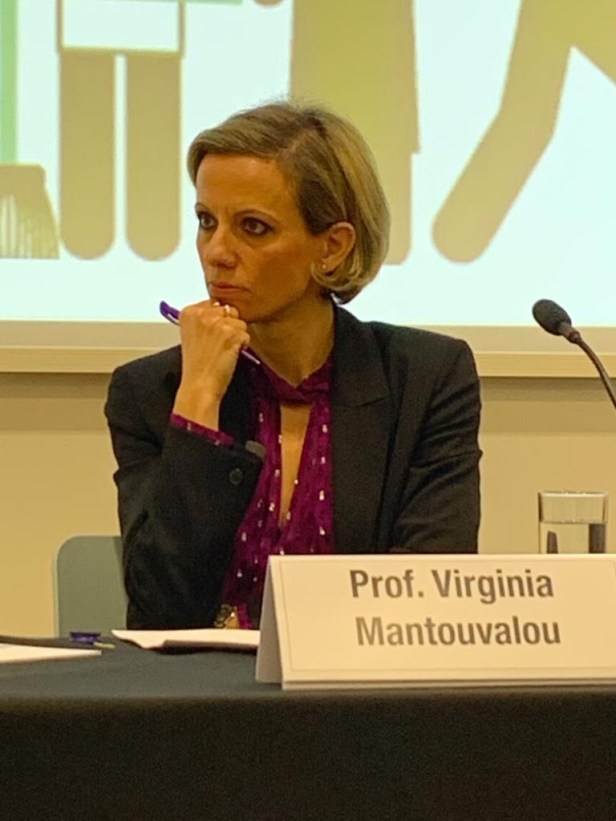
Virginia Mantouvalou is Professor of Human Rights and Labour Law at UCL, Faculty of Laws. Her books include Structural Injustice and Workers’ Rights (OUP 2023), Human Rights at Work with Alan Bogg, Hugh Collins and ACL Davies (Hart, 2024) and Structural Injustice and the Law with Jonathan Wolff (UCL Press 2024).
(Suggested citation: V Mantouvalou, ‘Review of the exhibition ‘Hard Graft: Work, Health and Rights’ at the Wellcome Trust’ UK Labour Law Blog, 13 November 2024 available at https://uklabourlawblog.com/)
 UK Labour Law